Contents
Floor insulation is a structural necessity when installing the ground floor structure on ground or insulating a floor slab. The ground acts as a high thermal mass whose temperature during most of the year is lower than the indoor temperature. Without thermal insulation, continuous heat transfer takes place between the floor structure and the ground.
The thermal insulation layer in floors limits this flow and allows the designed thermal resistance parameters of the floor to be achieved. The insulation must also withstand long-term loads, because the floor structure transfers operational and structural loads to the base.
Therefore, floor insulation structures use expanded polystyrene of the required compressive strength and design thickness. Its type and layer thickness are selected according to the load level, the building purpose, and energy efficiency requirements.
The most commonly used material for floor insulation is expanded polystyrene. It has excellent thermal insulation properties, high load-bearing capacity, does not absorb water, and maintains its properties over time.
Below are insulation solutions for floors on ground, floor slabs, and joist structures, following structural sequence and technical requirements.
Foundation footing installation
Ground floor structures in private houses are most often installed directly on the ground. Such a system requires a properly prepared base, because the stability of the entire structure depends on it.
First, the topsoil layer is removed and the construction site is leveled. The reliability of the foundation footing depends on the condition of the soil and the quality of its preparation. The structure must rest on a stable, homogeneous base with sufficient load-bearing capacity. If weak, fill soil, or peat soil is found, it is excavated and replaced with mineral material. In some cases, piles may be required to reach stable soil.
The base under the foundation footing can be formed from crushed stone or gravel – the choice depends on soil properties and loads. Crushed stone, due to its angular fraction, has better interlocking and higher shear resistance, therefore it is suitable for more difficult conditions or higher loads. Gravel is a more economical alternative and is suitable in stable soil conditions with sufficient bearing capacity. In both cases, the material is poured in layers and compacted mechanically. The thickness of one compacted layer is limited to ensure uniform density and eliminate voids.
A footing is installed on the prepared base. Its purpose is to distribute loads into the ground and create a rigid support surface for the subsequent structure. The footing may be formed from concrete or EPS 200. The concrete class, footing thickness, and amount of reinforcement are determined according to structural calculations. The reinforcement is lifted from the base to create a protective concrete layer.
In solutions where the aim is to reduce the thermal bridge in the foundation zone, high-compressive-strength expanded polystyrene, for example EPS 200, may be installed under the concrete footing. In this case, the quality of the base preparation becomes especially important, because the insulation layer must rest on a level and evenly compacted surface.
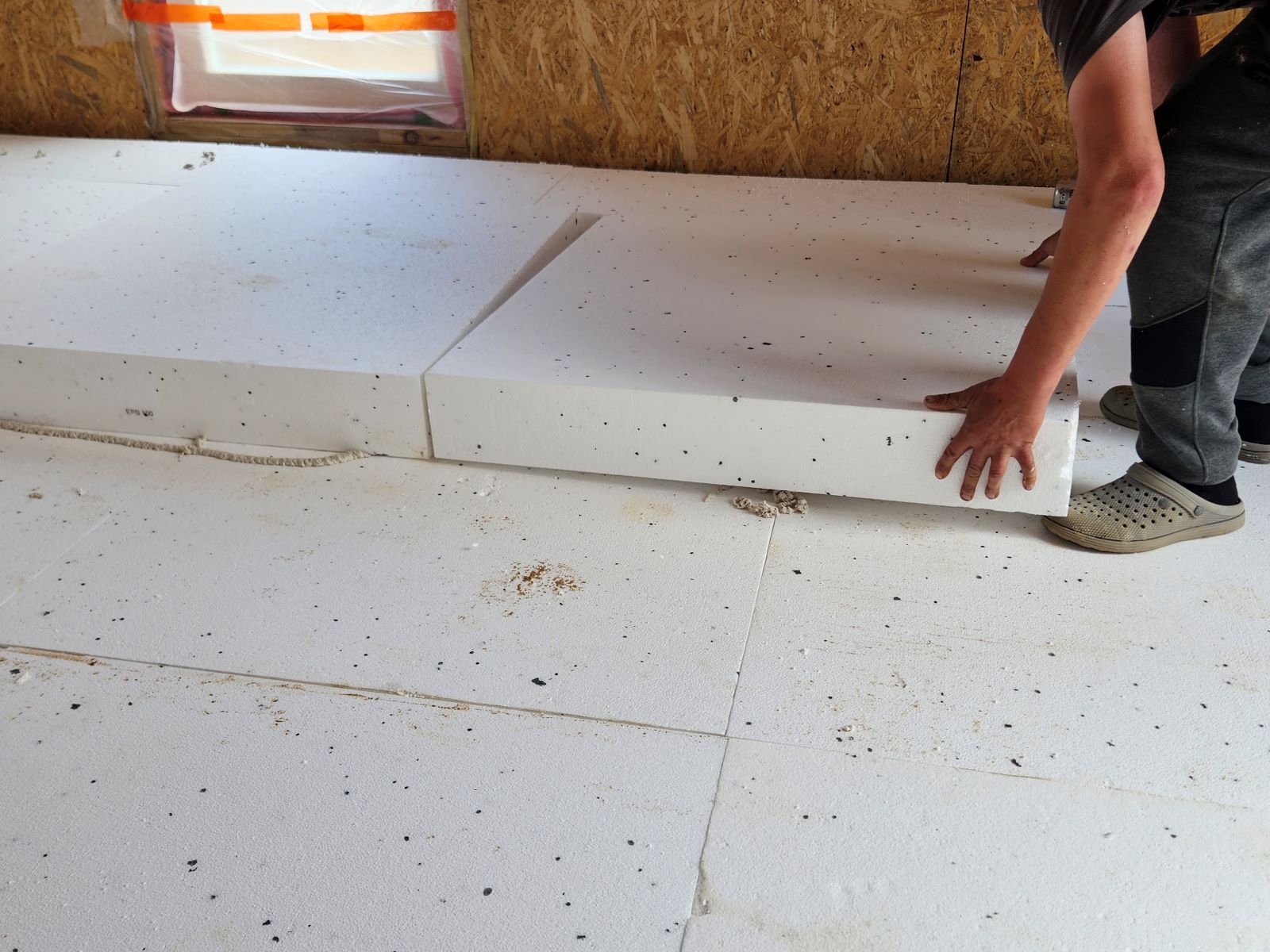
EPS boards are laid tightly together, and the surface must form a continuous support for the concrete. EPS 200 is selected because of its sufficient long-term compressive strength, allowing loads to be transferred into the ground without significant deformation.
Foundation insulation
Today, strip foundations are most commonly installed, while slab foundations are less common. Concrete blocks mounted on foundation pads are often used for strip foundations. The blocks are reinforced and filled with concrete. After the concrete hardens, the foundations are insulated from both the outside and inside with expanded polystyrene.
After the foundations are installed, utility lines are installed. Water supply and sewage pipes are installed in the ground, reaching the designed connection points. If the soil is unstable, a 10–20 cm thick layer of crushed stone or gravel is formed under the pipes and compacted. Sand with a 0–4 mm fraction is used to protect the pipes from deformation. The sand is poured and compacted in layers up to 15 cm thick. Gravel is compacted mechanically, and the surface is leveled to the design elevation. The height must be coordinated with the planned floor layer thickness and the bottom of doors or windows.
Leveling the sand base for floors requires professionalism. A uniform level must be maintained along the entire perimeter of the room. Gravel is leveled using screed rails and checked using a long spirit level, removed in some places and added in others. After initial leveling, the base is compacted again and supplemented with sand if necessary.
Film under floors
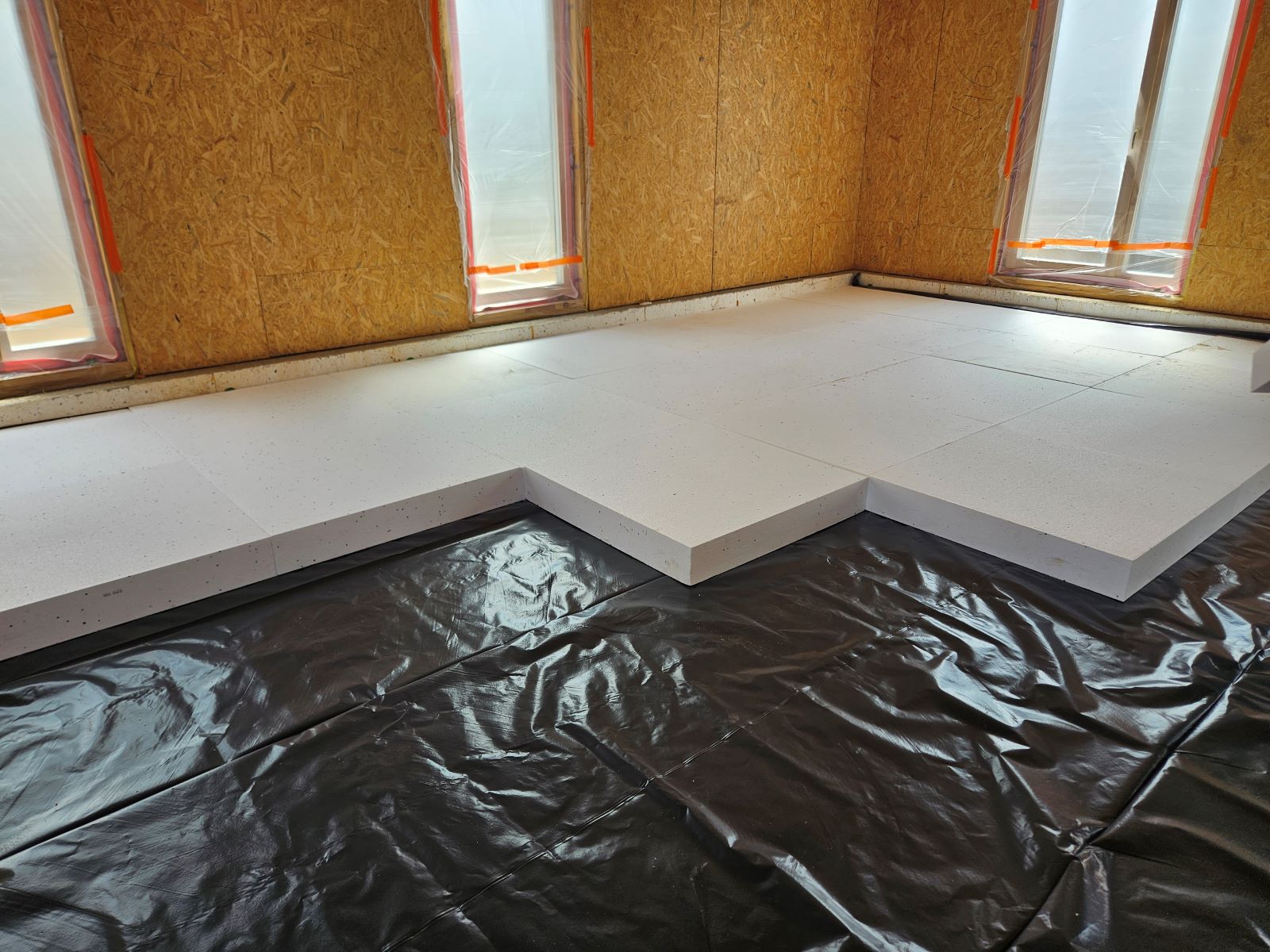
A separating layer is laid on the compacted gravel. Its purpose is to isolate the loose base from the thermal insulation. For this purpose, 200-micron polyethylene film or geotextile is used. The material is laid with a 20–25 cm overlap. The joints are not taped, because this layer does not function as a sealed waterproofing layer.
Expanded polystyrene for floors
Expanded polystyrene used for floor thermal insulation is selected according to compressive strength requirements based on loads. The designation EPS 70, EPS 80, EPS 100, or EPS 200 indicates the material’s compressive strength in kilopascals at 10% deformation.
Considering long-term creep behavior, it can be assumed that:
EPS 70 is suitable for loads up to approximately 2100 kg/m²,
EPS 100 – up to approximately 3000 kg/m².
For residential floors, EPS 70 or EPS 80 is usually sufficient. EPS 100 is used in garages, sports halls, or rooms with higher loads. EPS 200 is used for archives, warehouses, or industrial premises. Between wooden joists, EPS 50 is sufficient because the load does not act directly on the insulation.
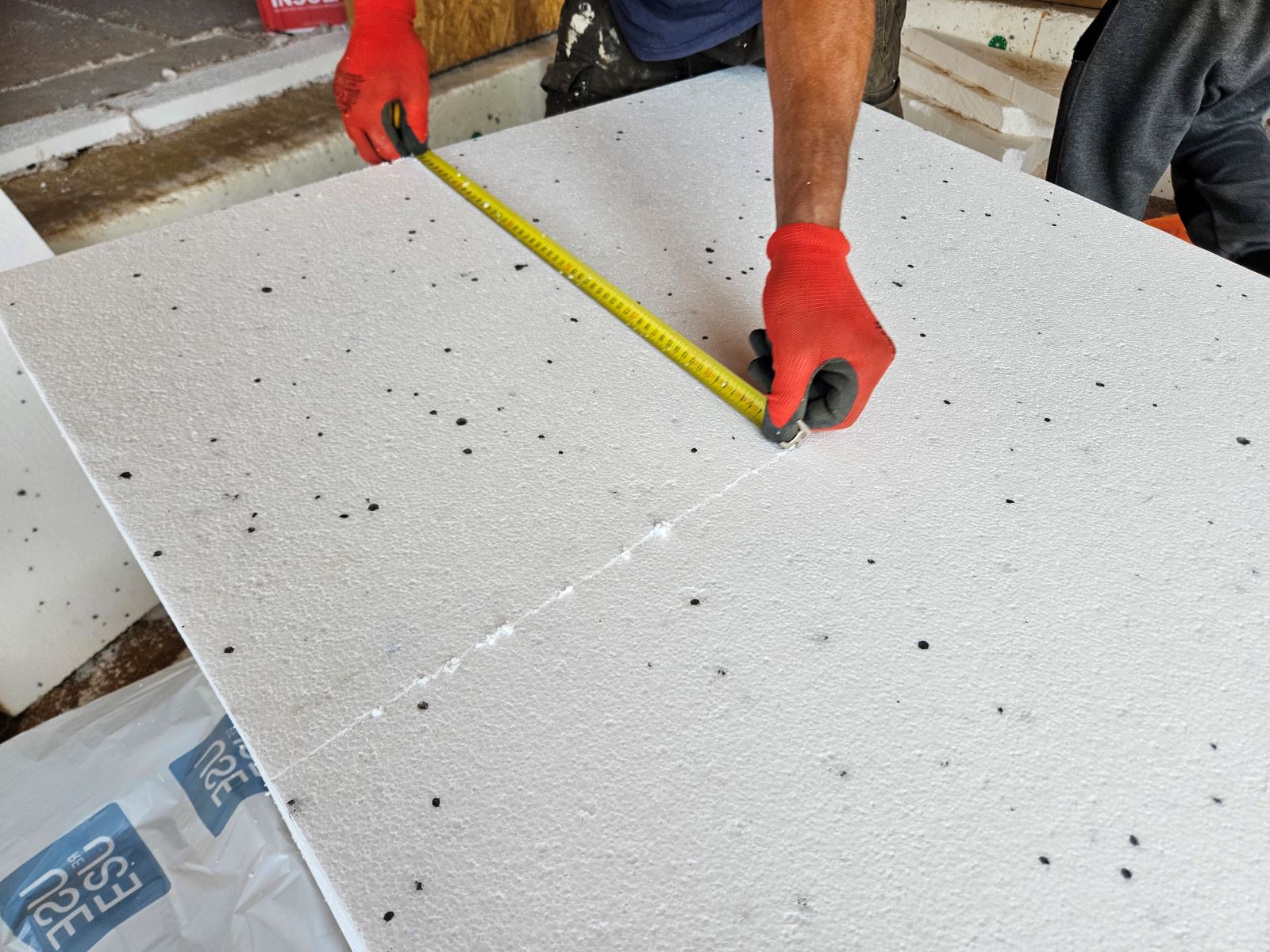
EPS boards are laid so that the joints do not align. If two or more layers are used, the upper layer must cover the joints of the lower layer by at least 20 cm. Boards can be cut using a knife, saw, or special heated cutting equipment.
Thermal insulation thickness for floors on ground
In floor-on-ground structures, the thermal insulation layer is calculated according to the required floor thermal resistance (R) and the declared thermal conductivity coefficient (λD) of the expanded polystyrene used.
The calculation is carried out according to the formula:
R = d / λ
R – thermal resistance (measured in m²·K/W).
d – material layer thickness in meters (m).
λ (lambda) – material thermal conductivity coefficient (W/(m·K)).
In high energy efficiency class buildings, the design thermal resistance of floor structures approaches 8 m²K/W. Using standard white EPS (λ ≈ 0.037–0.038 W/mK), such thermal resistance can only be achieved with a 30–40 cm thick layer. Using gray (graphite) EPS (λ ≈ 0.031–0.032 W/mK), the required thickness is smaller.
Below are approximate layer thicknesses for floors on ground when the thermal insulation is installed under the reinforced concrete layer.
EPS type | A class | A+ class | A++ class |
EPS 70 | 26 cm | 30 cm | 36 cm |
Neo EPS 70N | 22 cm | 25 cm | 30 cm |
EPS 80 | 25 cm | 29 cm | 34 cm |
Neo EPS 80N | 21 cm | 25 cm | 29 cm |
EPS 100 | 24 cm | 27 cm | 32 cm |
Neo EPS 100N | 21 cm | 24 cm | 29 cm |
The difference between standard and graphite EPS results from the lower λD value. In practice, this allows the overall floor build-up height to be reduced by 3–6 cm.
If the building is being renovated and room height is limited, it is allowed to install a thinner layer, however, in such a case the floor thermal resistance will not meet high energy efficiency class requirements.
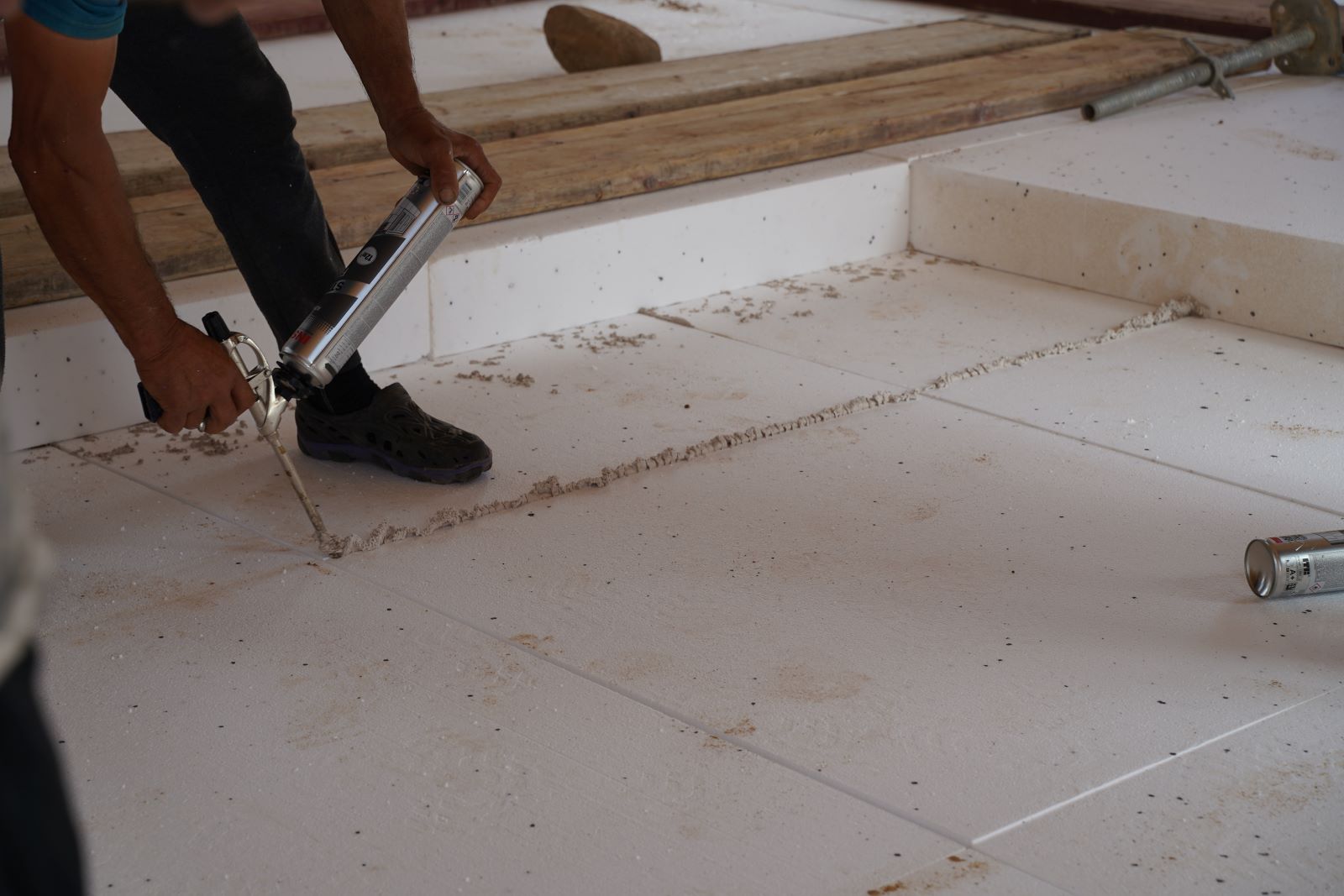
The insulation is installed in at least two layers. The joints between layers must not align. The recommended minimum joint overlap is 200 mm. Bonding the layers together is not required if the surface is level and the loads are evenly distributed, however, in practice installers often glue the boards together with installation foam to reduce board movement during concreting.
Concrete layer above thermal insulation
A reinforced concrete layer is installed on top of the installed expanded polystyrene. Polyethylene film above the EPS is used only when the floor structure is designed as a floating floor or when it is necessary to form a sealed vapor barrier. If the design does not require this, concrete may be poured directly onto the insulation.
The reinforcement mesh must be lifted above the expanded polystyrene so that it is positioned in the lower part of the concrete layer. A mesh lying directly on the insulation has no structural effect and does not carry tensile stresses.
The thickness of the concrete layer without underfloor heating is selected according to the loads and the stability of the base. In residential premises, where loads are low and the base is stable, 60–70 mm of reinforced concrete is usually sufficient. An 80–100 mm layer is used when loads are higher, greater rigidity is required, or the base is less stable. This is not a mandatory “standard,” but a solution selected according to project conditions.
If sand-cement concrete is used, the layer must be thick enough to ensure proper reinforcement performance and even load distribution. During concreting, the room temperature must not be lower than +5 °C. During the first three days, the concrete must be protected from drafts and excessively rapid drying in order to avoid surface cracking.
Installation of insulation under heated floors
The structural insulation arrangement for heated floors is the same. The only difference is that in heated floor structures, a special reflective and vapor-insulating film is laid above the expanded polystyrene. It forms a sealed layer and limits moisture penetration into the structure from the concrete side. The reflective surface is facing upward.
The film is laid with a 100–150 mm overlap, and the joints are sealed with aluminum tape or a tape intended for this purpose. Along the perimeter, the film is extended onto the walls up to the planned concrete height.
Heating pipes are installed on top of this layer – they are fixed to the reinforcement mesh with plastic fasteners or mounted into system boards with fixing clips. The most commonly used method is the embedded pipe method. Pipe spacing is selected according to heat loss calculations, typically 100–200 mm in practice.
The concrete layer must completely surround the pipes. The minimum thickness above the pipe is 30 mm, while approximately 45 mm is recommended. A perimeter expansion strip is installed so that concrete expansion and movement are not transferred to the walls.
Electric underfloor heating
In high energy efficiency class buildings, where heat demand is low, it is economically unjustified to install a thick concrete layer with a pipe system. In such cases, the following are used:
electric heating mats under tiles,
carbon fiber (infrared) films under floating flooring,
foil-type electric heating films.
The mats are embedded in the tile adhesive layer. The films are installed on special heat-reflective underlays. If only part of the floor area is covered, the remaining area must be compensated with an underlay of the same thickness so that the floor surface remains at the same height.
Electric systems do not require a thick thermal mass, therefore they react more quickly to temperature changes.
Dry floor installation
In periodically heated premises, such as holiday houses or rarely used homes, a massive concrete floor structure has a clear disadvantage – during periods without heating, the concrete cools down significantly and later takes a long time to warm up. Even after increasing the air temperature, the floor surface remains cold because the structure has high thermal inertia.
In such cases, dry floor boards are installed above the thermal insulation instead of concrete. Special gypsum fiber floor boards are most commonly used, forming a rigid but lightweight layer. The boards are laid in two layers, with joints offset by at least 200 mm, and the layers are glued together to form a continuous structure.
A dry-type underfloor heating solution is also possible, where heating pipes are installed into boards with grooves for the pipes. Dry floor boards are laid on top. Such a system makes it possible to avoid concreting and maintain a low construction thickness and weight.
An alternative solution is to install infrared heating film on top of the expanded polystyrene. It is laid under a floating floor covering without using concrete or heavy leveling layers. In this case, the heating is installed as a lightweight dry-type system that reacts quickly to temperature changes.
The advantage of this system is that there is no need to wait for concrete curing or drying, therefore the final floor covering can be installed immediately. The structure heats up quickly and does not accumulate excess cold.
The main requirement for such a system is a level and stable base. If the sand or gravel layer is not precisely leveled, the panels or coverings may deform. In practice, a thin leveling layer of sand-cement concrete without reinforcement is often installed to form a stable base, and only then are the thermal insulation and dry floor structure installed.
Floor slab insulation
In apartment buildings or private houses above basement spaces, the floor base is a concrete slab. The surface may be level or uneven.
If the unevenness is minor, it is leveled using a self-leveling compound. For larger differences, a sand-cement concrete layer is used.
A vapor barrier may be installed on the leveled base. Expanded polystyrene is then laid on top. It performs:
a thermal insulation function,
an impact sound insulation function.
For sound insulation, elastic EPS T-type foam is used, 2–5 cm thick, depending on the required acoustic effect.
The main EPS layer is installed above this layer. In practice, a total thickness of at least 100 mm is recommended. If room height allows, a 150 mm layer improves both thermal and acoustic performance.
If the slab is very uneven or contains beams and voids, leveling it with concrete is uneconomical. Possible solutions include:
filling cavities with cut expanded polystyrene,
filling with expanded clay aggregate and forming a leveling layer.
Floors on joists
Joist floor structures are used both on floor slabs and on ground. On ground, adjustable piles or threaded supports are most commonly installed, allowing precise leveling of the structure.
It is recommended to design a two-level joist system:
lower load-bearing joists – 50×100 mm or 100×100 mm,
upper joists – 50×50 mm.
Expanded polystyrene is installed between the first layer of joists (EPS 50 is sufficient because the load does not act directly on the insulation). This layer performs a thermal insulation function and, if necessary, a sound insulation function.
After installing the second row of joists, an additional foam layer is installed between them. It is desirable for the insulation to cover the inner edge of the foundation and reduce thermal bridges.
There are two main methods of installing supports:
The load-bearing joists are installed on the first insulation layer and concreted in place. The work is carried out faster, but a larger thermal bridge is formed.
Threaded rods are concreted in place, and the joists and insulation are mounted on them. Thermal bridges are reduced, however the amount of work is greater.
The subfloor is installed on the upper row of joists. The final floor covering is then laid.